02Delivery
Who’s going to build it?
Fixed scope, in phasesHow it works

For OneHope · Jubilee 2025, Rome
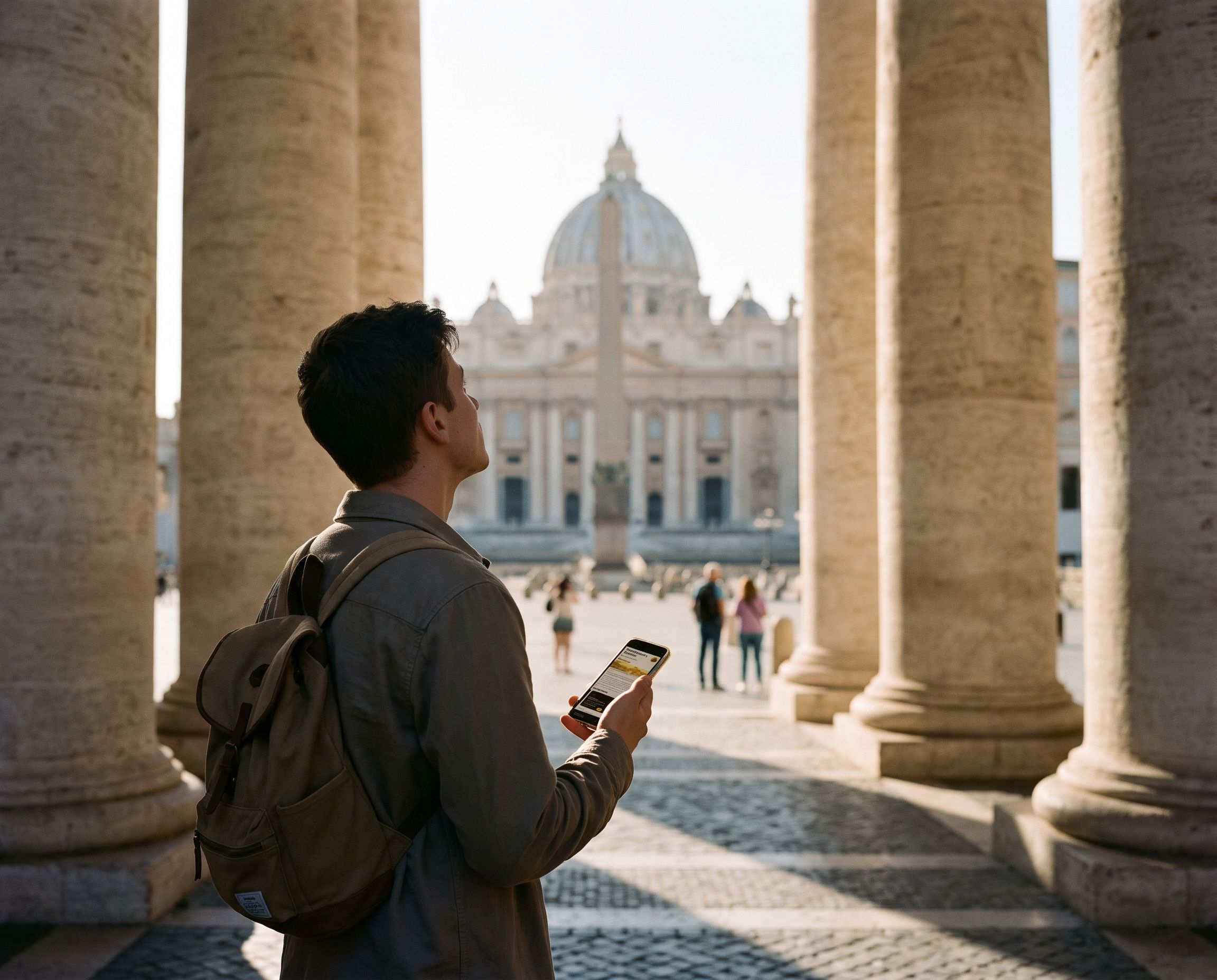
A web app for pilgrims at the 2025 Jubilee in Rome, built in 60 days on OneHope’s designs: ten sites, two routes, and seven days of reflections, in five languages.
What they asked
The Jubilee is the Catholic Church’s holy year, and in 2025 Rome expected more than 30 million pilgrims. OneHope, our client on Called to Thrive, wanted to walk with them: a companion for the city’s sacred sites, opened from a QR code, with nothing to install.
OneHope designed it. They gave us the screens and a detailed outline of how it should work, and about 60 days from sign-off to launch. They also wanted accounts: every pilgrim would sign in, and OneHope could follow each one’s progress.
What was really going on
Accounts sound small, but they aren’t. Sign-in, passwords, personal details to protect, and servers that answer every pilgrim one by one. That meant a bigger budget, more to build, higher hosting bills, and a real risk of missing the date.
And everything else was already hard. The app would run in five languages, English, Spanish, French, Italian, and Portuguese, and most of the translations hadn’t been written yet. Pilgrims would open it on a roaming phone, or on the crowded Wi-Fi around the Vatican, so it had to load in a moment, every time.
So we asked what OneHope would do with an account for every pilgrim. The more we worked through it together, the clearer it became that they didn’t need one.
The call
Instead of a sign-in, a cookie on each phone remembered which sites the pilgrim had visited and the day they’d started, so they could come back, tick sites off their list, and find the right reflection each morning and evening. With nothing personal to look up, every page could be made in advance and served from Cloudflare’s network, close to the pilgrims, so a crowd would be no harder to serve than one pilgrim.
The trade-off: OneHope gave up knowing who its pilgrims were, and each pilgrim’s progress lived on one phone. Switch phones, or clear the browser, and the list started again.
What we did
OneHope designed the app and wrote every word. We built it on their designs, turned their outline into a working app, and hosted it.
Context for each, from St Peter’s Basilica to the Colosseum, with videos from partners like The Chosen, and a check-in to tick it off.
Themed walks between the sites: “A Priceless Inheritance” and “Hope Through Trials”.
Seven days of reflections, morning and evening, counted from the day each pilgrim began.
Lectio Divina, a slow, prayerful reading of scripture, at two of the sites: the words scroll on screen as the audio plays.
Five languages, built so each translation could go live the day it came in, without waiting on us.
The role
Duncan Platt led the build, with Daniel Hall, who led the project at OneHope, as he had on Called to Thrive. OneHope designed the app and managed its content; we built it and hosted it.
The app
The home screen greets pilgrims for the time of day and suggests a route. At each site, a check-in ticks it off, with what to notice while you’re there and videos to watch. At two sites, a Lectio Divina reads scripture aloud as the words scroll by.


What changed
We started on 7 October 2024, and the app went live on 5 December, almost three weeks before the first Holy Door opened on Christmas Eve: ten sites, two routes, seven days of reflections, and two Lectio Divina experiences, with each language going live as its translation arrived.
It was simpler to build and cheaper to run than an app with accounts, and there were no pilgrims’ names or passwords to protect.
Afterwards
By the Vatican’s count, about 33.5 million pilgrims came to Rome from 185 countries during the Jubilee. The Holy Doors closed in January 2026, and with them the year the app was built for.
We hosted the app for OneHope, and their team managed it and its content.
Who carried it forward
OneHope’s team, who managed the app and its content. We hosted it.
In their words
At OneHope, working with Duncan and BoldOrion felt like having someone on our team who understood both the technical challenge and the heart of the mission. Duncan brought real quality to the work, spotted problems we might otherwise have missed, and was the person I trusted when something complicated needed solving. He didn’t just build what we asked for, he helped us make it better.
 Daniel HallDirector of Digital Program Development, OneHope
The service behind it
02Delivery
Next case study
Voice AI startup · Plumbing and HVAC
Talk it through
That’s usually the right place to start.
A conversation, not a pitch. If we’re not the right fit, we’ll say so, and point you to who is.