03Fractional CTO
Who’s making the technical calls?
Two quarters, then reviewHow it works

Voice AI startup · Plumbing and HVAC · 2021–2022
Advising the founders of a voice AI startup for plumbing and HVAC firms: drawing the product with them, rebuilding the team, and keeping founders and engineers on the same page.
What they asked
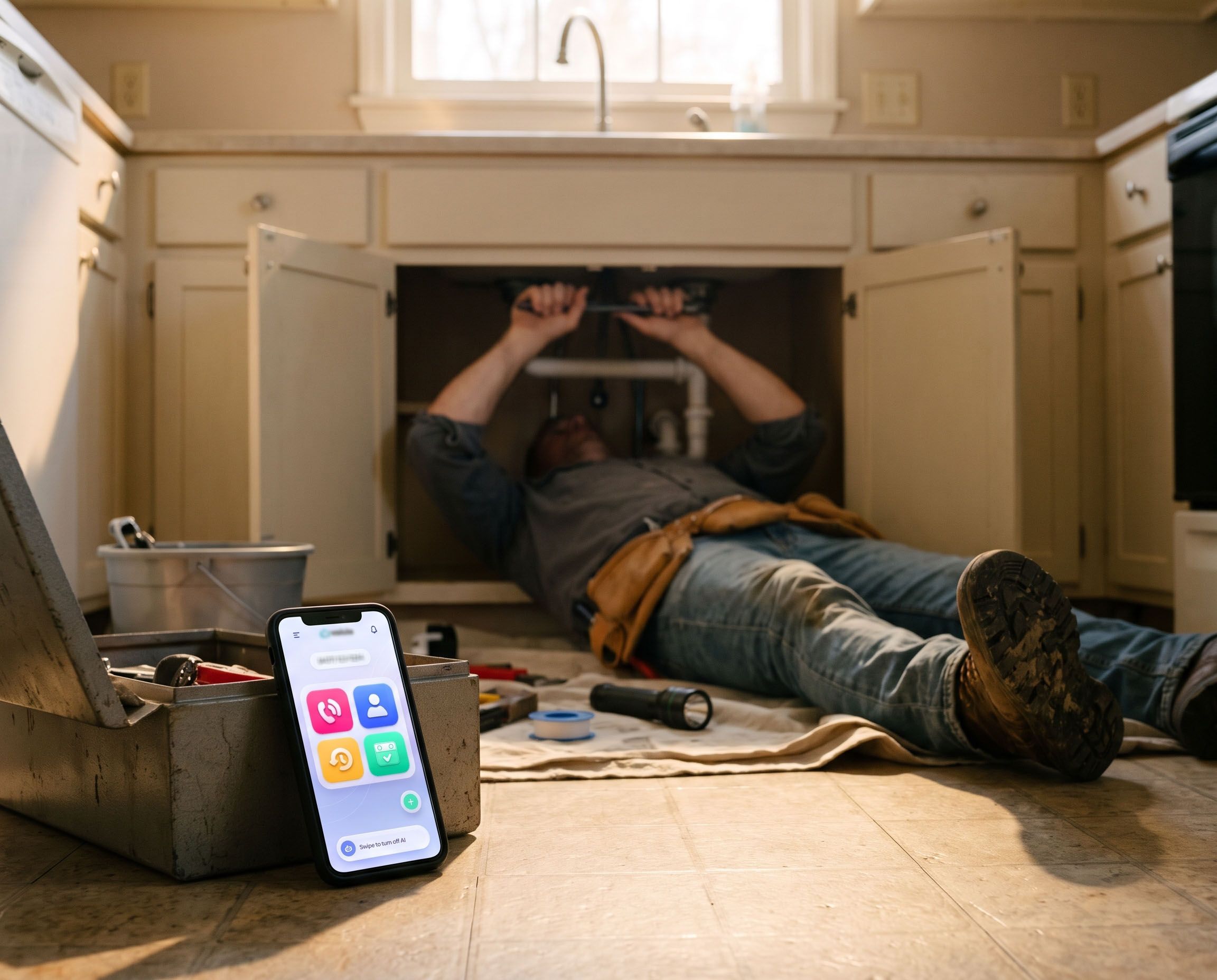
Plumbers and HVAC technicians miss calls all day, because they’re under a sink when the phone rings. Two founders set out to answer for them: an AI voice, on an ordinary phone line or by text, that took the call, booked the job, ran the card, and handled the rescheduling, inside one app for billing and calendars.
They knew phone systems well, and one of them, the CTO, was building the AI pipelines himself. But their offshore team was slow, and what it shipped didn’t look like what they pictured. Why was it taking so long?
What was really going on
We started by listening: where the founders came from, where they wanted to go, and how they pictured the pieces fitting together.
Their picture was clear, but only to the two of them. Nobody had broken it into steps an engineer could pick up. So the engineers built the parts they could follow, mostly screens, and the hard problems waited. Interfaces were going up before anyone had settled the problem, the user, or what to build.
More pressure on the same team would only have produced more screens.
The call
Everyone had good ideas, and the easy path was to keep adding them. Instead every idea met one question: is this the simplest thing that adds value for the person under the sink? For every yes there were about three nos. The first version would take the call, book the job, run the card, and reschedule. And it needed engineers who would solve problems, not just close tickets.
The trade-off: a smaller team that cost more than the one before, and a long list of good ideas left for later.
What we did
The founders made the calls. We made their picture something a team could build from, and found the people to build it.
Time with the founders and the team first: the world they came from, what led up to this product, and where they wanted it to go.
Whiteboard sessions that named every part of the machine, agreed what each one meant, then walked a caller through it to every point where a call could end. About three sessions in, the founders saw their product whole for the first time.
Not the least we could ship, but the simplest thing that adds value for the end user. We asked it again and again, until the team asked it too.
We wrote the roles, posted them, and interviewed alongside the founders. Two engineers joined, both former founders used to working close to customers, and over 60 days the old contractors were phased out.
The role
Duncan Platt advised both founders from 2021 to the end of 2022: the bridge between what they pictured and what the engineers built, and the lead on hiring. The AI pipeline was built by the founder who was CTO, with the two new engineers.
What changed
In January 2022 the platform took its first live calls: an AI voice on an ordinary phone line, booking jobs and taking payment through Stripe, about eleven months before ChatGPT launched. The pieces had worked on their own before. What changed was that they worked together.
The new team cost more than the old one. By our estimate it shipped ten times faster, and it shipped the right things.
Afterwards
At the end of 2022 the founders saw a bigger opportunity in COVID-era tax credits, and put the voice platform on ice before it reached paying customers.
The two engineers went with them, built the tax credit platform, and have been at the centre of the firm’s work since. A few months later, the founders called us again.
Who carried it forward
The two engineers we hired. They became the founders’ core team, and built their next platform.
The service behind it
03Fractional CTO
Next case study

Tax credit platform
Talk it through
That’s usually the right place to start.
A conversation, not a pitch. If we’re not the right fit, we’ll say so, and point you to who is.